
Blog: From the Head
Greetings.
My name is Kara Douglass and I am the Head of School at The Fulton School. Every other week, I'll post here about the mission of our school, our curriculum, highlights of being an independent school, and even parenting (I'm the mother of five children). If you're a visitor here on our website, we hope these blog posts will give you a glimpse into our community.
Feel free to reach out to me. You can call the school at (314)469-6622 or email me directly at [email protected].
Click on a link below to see my blog posts:
Blog Post | October 8, 2026 | What Does Screen Time Take Away?
Dear TFS Community,
One of the biggest questions parents share is how to manage screen time with their children. Interacting with screens seems too big of a part of our lives to avoid completely, and yet the American Academy of Pediatrics and a range of many other child development experts recommend minimal to no screen time for the youngest children and limited time on screens for older children. Yet our kids beg for it, we use it productively and purposefully in many instances, and there are a lot of good and fun elements to it. I want to propose a different framework for thinking about screen time.
What is screen time taking away?
Every minute your child is on a screen, an activity in real life is not happening. Is screen time replacing deep or reflective thinking? Boredom? Arguing with their siblings? Listening to music? Waiting for you on your phone call? Helping with cooking? Playing with Legos or riding their bike outside? It turns out, with a generation of kids who grew up with personal devices, that all of these activities are necessary for healthy emotional, social, and cognitive development. It can be easy to forget these childhood needs when screens are so readily available and so luring.
The biggest catch is, that the more a child is on a screen (and used to the dopamine it provides) the less they want to do the above activities. So they truly seem like a kid who just doesn’t like Legos or riding their bike; they don’t seem like a child who loves to create games out of nothing or find joy in mundane activities like cooking. These activities cannot produce the same dopamine hit that a screen provides, so the child does not find them enjoyable. They are low dopamine or “slow dopamine” activities, and they are what we all need to live on in order to be functional adolescents and adults.
A need for high dopamine is associated with anxiety, depression, ADHD, and addictions as we get older, so it’s something to be thoughtful about in our younger children. Does it mean that we will have to break up more sibling arguments, listen to high-pitched kids’ songs in the car, and face a lot of whining and eye-rolling? It may! But each time you feel your own aggravation and exhaustion, remind yourself that you’re giving your child the gift of managing real life, rather than escaping it. Feel proud of yourself and stay strong!
If you ever want to meet to brainstorm about reducing screen time and building child-centered life management skills in your household, I’m happy to think through it with you. I know firsthand the challenges involved, and am happy to walk alongside you.
Warmly,
Kara
Blog Post | September 6, 2026 | Curriculum Night
Dear TFS Community,
Tomorrow is our Curriculum Night, our annual event dedicated to educating you about how and what we teach.
The Montessori material is brilliant, complex, and unique – you could come for years and still have more to learn about the depth it offers your child! Starting in 4th grade, we pivot to a college-preparatory curriculum and deliver that material in engaging and creative ways. We want you to experience these classes in order to understand what your child is experiencing here at TFS. We know you will be impressed by the hard work the teachers put into taking good care of your children.
Every teacher in the school will be presenting. You will choose three presentations to attend; you do not have to choose presentations strictly from your child’s classroom. Topics range from Toilet Training to Executive Functioning to Wuthering Heights, with a thorough offering of the Montessori Math, Language, and Practical Life curriculum.
We look forward to seeing you all there.
Warmly,
Kara
Blog Post | August 26, 2026 | A New Year Underway
Dear TFS Community,
Welcome to a new school year! The start of school always feels more like New Year’s Day to me than January 1 ever has. There's an anticipation in the air that new things are coming. The kids are fresh and eager to start new classes and projects. The teachers have worked, sometimes all summer, to create beautiful and stimulating work spaces and are delighted to share those with their students.
We are excited about a few projects around the building too. You may have noticed that the Art Room moved. Mr. Apollo, Mrs. Jensen, and various contractors worked hard to add plumbing and construct cabinets so that our Art program could enjoy a bigger, more open space. It is so fun to walk by and see the students creating in that beautiful space.
Construction will start tomorrow on a Makerspace Expansion (after weeks of delay waiting on St. Louis County). This Upper School space for STEAM (Science, Technology, Engineering, Art, Math) projects houses a laser printer, laser cutter, two 3D printers, and multiple opportunities for programming, carpentry, and, well, almost, anything you can think of! Students use it for academic assignments, creative projects, and entrepreneurship. They graduate with an impressive portfolio and blog to share with colleges as part of the college admissions process. Upper Elementary students can participate in Summer Camp here, which is a great introduction to learning this complex system of machines, all the while dreaming of what they will create as they move into Upper School.
The remaining Dining Room space will continue to be used for lunch, the honey harvest, class cooking projects, and other out-of-the-classroom activities. We will host upcoming parent and community events in the Meeting Room or gymnasium.
We welcome all of you to check out the Art Room and Makerspace next time you are in the building!
Warmly,
Kara
Blog Post | December 10, 2025 | Screen Time Part 4
Dear TFS Community,
The last challenge I’ll leave you with regarding this fall Screen Time Series:
Is your child engaged in real life during his/her free time?
Are you making time for family games and shared experiences--a game of Uno, or reading aloud together?
Do you let them (even push them!) to take risks and do age-appropriate hard things that create a little thrill?
Are they experiencing the slow gratification of contributing to the family through chores and working on skills that require practice, like puzzles, a musical instrument, a sports team, or getting a job?
We cannot simply limit screens and the constant dopamine rush they’re offering. We have to provide enriching opportunities for them to develop the skills to live real life, and to love living real life. Low dopamine time (boredom, chilling), slow gratification, learning to take small risks, and contributing to the world are some of the most important categories for you to think about creating. And, of course, any time they spend playing with you is time that creates warm, cozy, secure feelings (oxytocin releasing in the brain) that are the foundation of a loving home.
Below is a list from “Let Grow” with challenges for kids at every grade level to tackle per some of the above goals. Take a look at it and see if your child(ren) can choose one or two to accomplish over winter break. There is also a Good Tech Gift Guide that highlights tech options that don’t pull children away from life (and it’s at a website you might want to bookmark -smartphonefreechildhood.org).
I hope everyone has a wonderful holiday season,
Kara
Blog Post | November 19, 2025 | Screen Time Part 3
Dear TFS Community,
We have thought about how and when your children are having screen time, but the next thing to think about is their brains during screen time. If they are on screens, what are they NOT doing? What is the screen taking them away from? Outdoor play? Socializing (even arguing with siblings)? Chores/tasks? Boredom that might turn creative? Boredom that allows for downtime and rest? We have undervalued the skills kids are developing during unstructured down time, and screen time is undercutting the development of those skills.
Secondly, what type of screen time are the kids enjoying? All screen time is not equal. I created the chart below to challenge us all to think through the value of various activities on screens. Some of the best screen time can build relationships and intellectual engagement, if shared with others. A child’s brain processes a show differently, and much healthier, if it’s on a screen in the family room that others are watching, than if they’re alone on an iPad.
I think we’re all aware of the darkest vices of the internet, but maybe not some of the quieter threats. Infinite scrolling apps (social media, YouTube, TikTok) are very difficult for kids because the activity doesn’t have an end and creates an addictive chemistry in their brains. We all know that the formulas are created to keep us all glued to the screen. This is so much more dangerous to a young brain than to an adult brain.
Fragmentation is also a huge challenge emerging in children now. The term references an inability to think in longer narratives because of so much time spent on short clips. Fragmented thinking prevents the brain from knowing how to follow stories, books, conversation threads, logic threads, and even longer movie plots. So short clip apps are also a quiet threat to your child’s brain--her ability to think deeply, be a strong learner, and succeed in school.
As you think about your child’s requests for screen time, I challenge you to think about the chart below (attached). How engaging is the activity intellectually (beware of the short clips) and is there a way to use it to build connection? Can you put their show on a tv in your house that you watch while you cook dinner? Can you push them to watch a 30 minute show rather than something with multiple 10 minute shows? Can you play a video game together? Analyze the shows or games they like--is the vocabulary strong? Are there thoughtful plots? Is there character development? Do the values of the game match your family’s?
I hope this framework is helpful to you as you navigate this complex issue! I wish you all a wonderful Thanksgiving week and hope you have meaningful family time, building relationships and rejuvenating.
Gratefully,
Kara
Blog Post | November 19, 2025 | Screen Time Part 2
Dear TFS Community,
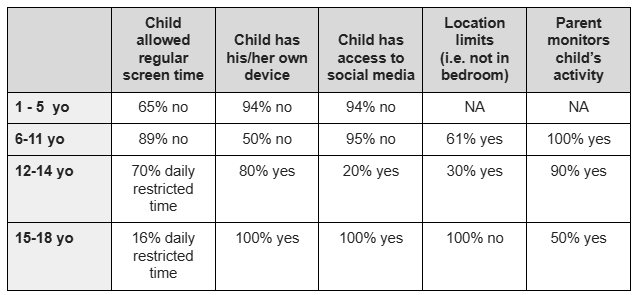
Thank you to all who filled out the screen time survey. We had really strong engagement, which shows me that this topic is relevant to you all right now! In his book and talks, Dr. Jonathan Haidt has one powerful stance for us all to consider. We are overprotecting our kids in real life and under protecting them online (watch this lighthearted, but poignant clip to see his point illustrated). He recommends (and the vast majority of educators, Gen Z, and parents of older kids support) four guidelines:
No smartphones/devices (access to internet) of their own until age 14
No social media until age 16
Phone-free schools
More independence and free play in real life for all ages
I will continue to elaborate on some of this in my upcoming Head’s Updates, but I am always happy to work with parents on any of this if you ever want to brainstorm about your family in particular. In the meantime, here’s the breakdown of the TFS survey results:
Blog Post | October 15, 2025 | Screen Time Part 1
Dear TFS Community,
At The Fulton School we are committed to healthy childhoods and helping you raise your child--your whole child. When we reference the whole child, we mean that they are not merely academic vessels that we must fill with knowledge, but complex individuals who thrive when working on social, emotional, and cognitive development.
Children are not born with the skills to regulate their emotions, concentrate on tasks they don't enjoy, or delay their gratification. These are necessary life skills that they must practice for years, evolving as their brains mature.
We are working to create a distinctive culture at TFS that prioritizes living in real life over virtual experiences: face-to-face relationships, real experiences, and deep dives into knowledge. We find that while technology is a wonderful tool for many tasks, it is also one of the most powerful threats to developing many of the skills children need for life. It can create unconstructive temptation--stealing time from healthy activity at best and destructive to ourselves and our relationships at worst. These challenges affect even the most mature, well-adjusted adults; how much more difficult are they for children who are still trying to figure out who they are and how the world works, with undeveloped brains, untrained hormones, and very little real world experience?
The vast majority of parents are aware of and even concerned about most of these threats, but we all struggle with the details of how and where to put a stop to it. In the fog of unclear boundaries, we all give in to the child’s persistent begging. Parents also feel tremendous pressure to override their instincts due to a fear of their child being left out. In national surveys, the vast majority of parents wish their children didn’t have devices, but admit that they gave in due to various social pressures.
I thought it might be interesting to get a sense of the Fulton School community approach. If you’ll fill out a survey here, I’ll share the data with everyone next and you’ll have a sense of how unique or common your family’s approach is. Click the following links to participate in a quick, four-question, community-wide survey!
Best,
Kara
Blog Post | February 6, 2025 | Montessori Through Childhood, Part 3
Dear TFS Community,
Erik Erikson wrote about how our psychosocial needs develop and change over time and argued that we are driven to accomplish a psychological goal at each stage of development. These completions prepare us to enter the next stage and as they layer upon layer throughout childhood, they provide us with the skills we need to thrive in adulthood. Erikson studied under Maria Montessori and they influenced each others’ work.
Before students enter our environment, in their first year of life, they are deciding whether to trust or mistrust the world. Babies are figuring out “hope” at its most primal level.
Toddlers: 1 - 3 Year Olds
Toddlers come to us with that sense of (or lack of) trust and begin working on “will.” Through their deep drive to be autonomous, they are developing their core sense of self confidence through their autonomy, or developing a sense of shame and guilt for wanting to be independent. Toilet training is a huge part of this stage, but Erikson argues, it is only one element of all that children have to accomplish at this stage. Feeding and dressing themselves, mastering their bodies (gross motor skills), and learning to articulate their needs and desires (talking) are major elements of this stage. A great example of how a Montessori classroom meets students appropriately at this stage is how the room is set up. Children are often asked to “share” at this age in social environments. But children really cannot cognitively comprehend sharing yet, so there is often conflict and big emotions when sharing is enforced in a way they cannot comprehend. The Montessori set-up allows for a protected space (your rug or your table) where you can explore and learn without threat. Teachers are trained to redirect students away from the same item, capitalizing on their innate curiosity and distractibility.
Children’s House: 3-6 Year Olds
In Children’s House, 3-6 year olds are achieving the developmental task of purpose through learning to take initiative. The entire classroom at this age is set up to encourage students to take appropriate initiative (choosing a work) and to discourage inappropriate initiative (bothering your neighbor). Children in this stage are so proud of their initiative, and when it’s developing well, work with immense purpose, propelling them to learn and grow and achieve from within. They will carry this deep sense of purpose with them through the next stages.
Elementary Years: 6-12 Year Olds
The elementary years are lumped together (we split them into two three-year periods for academic purposes) by most developmental psychologists. Erikson does as well, proposing that 6 - 12 year olds are developing a balance between industry and inferiority. They are driven to develop skills--there’s a reason this is the age most active in extracurriculars like musical lessons, athletics, dancing, coding, etc. They have a vast, sometimes insatiable interest in trying and practicing new skills. This drive will include the patience to work on mundane elements of these skills like typing, math drills, getting the fingering right on their instrument--a patience they will generally abandon during adolescence, unless they are already hooked. Children who move through this stage successfully will emerge with a core sense of competency. In Montessori classrooms, we offer a huge array of opportunities for them to fulfill this appetite for learning and growing. Because they aren’t driven primarily by initiative anymore, we have structures in place to hold them accountable, while they enjoy the fruits of practicing for mastery in many different areas.
Adolescence: 12-18 Year Olds
Adolescence is, of course, notorious for being a tumultuous time. Dr. Montessori described it as the tearing down and rebuilding of identity. Children who enter this stage with successful completion of other stages (they feel like they are good at doing things, have a sense of purpose, a will strong enough to stand through pressures, a self-confidence to do things for themselves, and a sense of hope that things will turn out okay) are going to have a completely different adolescence than kids who haven’t built these core instincts. Erikson observed that their major task is identity versus role confusion and argued that children who work through this stage will experience a sense of fidelity to themselves, sure of who they are, and their place in the world, so they can approach adulthood with confidence. In our Montessori-inspired Upper School, student opinions are welcome; students have a huge range of opportunities to engage in a variety of activities from Makerspace and travel to applying their interests in classes; students learn to advocate for themselves; and we do a lot of work on our school culture. Being in an environment where they are known well, where the general expectation is kindness, and where they are free and safe to work through all of this is a balm in a culture that is not all that healthy for this age group. Teens are bombarded with messaging that they are not worthy, not enough, and not capable, while facing immense pressure to be more and do more.
If you are still reading, thank you! I know this was a long one, but sometimes it’s important to dive deeper, although I’m barely skimming the surface of these theories.
Growing up is complex. We are proud to provide an environment that is good for your children and we are honored when you choose to partner with us to raise them.
Warmly,
Kara
Blog Post | January 22, 2025 | Montessori Through Childhood, Part 2
Dear TFS Community,
As children grow, we all recognize that their cognitive abilities increase, from concrete to abstract, from simple to complex, and from dependent to independent. But what does this look like in terms of our academic expectations and the classroom space?
If you walk from our youngest classrooms to our oldest classrooms, you will notice that the number of physical materials dwindles in direct proportion to the students’ age. This is not just because the students don’t need the materials, but they actually want them anymore! As a 2nd or 3rd grader begins to internalize complex math concepts, the materials actually begin to hold them back. A teacher will notice the child working on a rug with the materials next to them, but the student has abandoned them. Secondary students don’t need physical materials anymore, but they need experiences and connections in order to engage.
Most of the materials in the Toddler and Children’s House classrooms have fairly obvious purposes, even if one doesn’t know all of the reasons behind them. As the math gets more complex in the elementary classroom, most adults would not even know how to use the math materials--how does one do long division with manipulatives? How does a child do equations in the billions with beads (hint: they don’t have a billion beads!)? We generally learned these processes by rote when we were kids, so most adults cannot picture this concretely. As expectations get more complex, one-on-one conferences and feedback become essential so that we’re training critical thinking and communication skills, meeting each student where they are and pushing them from there.
Students don’t learn any of the concepts (such as What does a good paragraph look like? Why does it matter if a fraction is improper or mixed? Why does government matter?) in a single day anymore than you could learn another language or ballet in a day. We spiral over and over through every concept over the years. Students write paragraphs with the moveable alphabet, then with their hands, then we require mechanics like capital letters, then we require simple grammar, then we ask for the paragraph to stick to one topic, then we ask for structure like topic sentences and supporting details, then we ask for more grammar, then we ask for multiple paragraphs that connect, etc. The same thing happens with math operations, fractions, decimals, more complex operations, complex equations, word problems that have to be thought out, equations with letters in them, equations that are all letters, etc. With each level, students have to review and practice, then push a little further.
There is almost always a tension between students’ intellectual capabilities and their emotional, social, and psychological needs; in other words, attributes like grit, self-advocacy, frustration-tolerance, and curiosity will have a much greater impact on their achievements than their raw intelligence. Are they anxious about failing? Do they give up when discouraged? Do they refuse help because they’re overconfident? Do they hide and deflect? Do they compete with their peers, sacrificing care for speed? A strong education *must* address the whole child and not simply feed them information, so that these social, emotional, and psychological needs are tended to as well. More on that next week!
Warmly,
Kara
Blog Post | January 15, 2025 | Montessori Through Childhood, Part 1
Dear TFS Community,
As one of the only Toddler-through-12th grade Montessori schools in the country, we have the unique privilege of knowing and nurturing kids through every developmental stage. Working with the same child for 15, 16, and 17 years, aside from being an inspirational experience, is also a textbook lesson in child development.
A Montessori education nurtures the whole child (unlike the traditional aim of education which is isolated to knowledge or cognitive skills). We want to challenge children academically, but even more importantly, we want to develop academic skills--the skill of learning (concentration, self-discipline, initiative, independence, curiosity, self-advocacy, and critical thinking) is different than knowledge itself. We are also committed to developing social and emotional skills like communication, kindness, frustration tolerance, delayed gratification, impulse control, independence (again--it’s a big one), and gratitude.
Over the next few weeks, I’m going to share how Montessori looks at the various levels. How does the work evolve? How do teacher expectations change? How does student engagement change? This journey is probably my favorite part of working here, as our program evolves parallel to the child’s growth. We move from the concrete to the abstract; from simple to complex; from necessary for childhood to necessary for adulthood; and from how to take care of yourself to how to serve the world. It's a tall order, but fortunately Montessori has over a century of experience supporting our methods.
Warmly,
Kara
Blog Post: October 9, 2024 | Community Service
Dear TFS Community,
As a Montessori school, we believe philosophically in teaching the WHOLE child. This means that in addition to math and reading, our teachers and administrators put considerable time and care into nurturing social skills, character development, and work skills. We believe these “soft skills” are as important, if not more important, for life as academic skills. In fact, these soft skills feed and nurture the academic skills, helping the children blossom beyond what anyone may have expected.
Community service and generosity of spirit are elements of character education that we value. Students, even our youngest, give time to making our school community a better place by helping a friend, picking up trash or storm debris, putting the flag at half-mast, running our recycling program, or providing manpower in support of various events. As the students get older, we continue to find meaningful ways to help our community and the larger society around us by volunteering our time with local organizations.
This holiday season, our students will have three opportunities for you to help them help others. You will see notices in your newsletters and the Tuesday Memo. I thought I would introduce them here together, so you could see the connecting threads, and more practically, mark them on your calendar before it gets too busy:
Upper Elementary coat drive for Warner’s Winter WarmUp will run October 21 to November 1.
Upper School food drive will run the week of November 11 for the St. Louis Area Food Bank. Our 7th-12th graders will also have a community service day working there before Thanksgiving.
Lower Elementary toy and book drive will run the week of December 9 for The Leadership School in North County. These items will be part of a “free store” where parents with little disposable income can shop for holiday gifts for their children.
If you have the bandwidth, you could build on these opportunities by inviting your children to choose the items, give something of their own, or use some of their own money to experience how fulfilling giving can be.
Gratefully,
Kara
Blog Post | November 21, 2024 | Giving Thanks
Dear TFS Community,
As a child, my mom would often challenge me to count my blessings. This intentional practice always improved my outlook on life. There has been a lot of research in the last 20 years validating my mom’s suggestion. It’s true--being grateful changes us for the better. Next week, our entire nation will pause from all of our work and activities to count our blessings. How great is this for all of us!? In preparation, most of our students have participated in some sort of activity related to being thankful. Their comments are always so fun to read or hear, and they make me think of a few things that I am grateful for in our community:
-I’m grateful for our committed and passionate teachers – teachers who care for each child, who are willing to give up personal family time to travel with the kids, who show up for their coworkers, who put their egos behind them and our mission in front, who play with the kids, who research and learn in order to improve what they do each year.
-I’m grateful for Dr. Montessori and her work. As hard as implementation of, communication about, and training for this brilliant method is, it’s SO worth it to observe how the children grow in their confidence, curiosity, knowledge, and studentship
-I’m grateful for so many warm and trusting relationships between teachers and students, parents and teachers, and between the students themselves. Connections like these nurture us all, and help kids grow up well.
-I’m grateful for the time the kids get to explore and play and build on our property.
-I’m grateful for the smell in the building when classes have been cooking.
-I’m grateful for happy noises coming from the gym during PE and high school sports (and this week’s Harvest Hoedown rehearsals).
-I’m grateful for the kindness of our kids (and for the teachable moments when they’re not so kind).
-I’m grateful for sweet toddler walks, where they absorb the world around them wide-eyed.
-I’m grateful for the meetings I get to have with kids who have made poor choices--to hear their hurts and frustrations, to sit with them in that pain, but then help them turn towards better decisions through reflection, logic, and accountability.
-I’m grateful for all of the opportunities the students have to make and create and turn their ideas into realities in class, in Makerspace, at recess, in circle times, on trips--anywhere and everywhere!
-I'm grateful that I get to come to work every day with such an inspiring group of colleagues and students who fill my heart.
I wish you a wonderful season of giving thanks.
Warmly,
Kara